

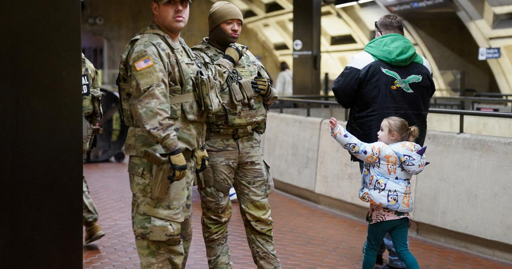
In August 2025, residents of Washington, D.C., awoke to a sight familiar in much of Latin America but rare in the United States: uniformed military troops patrolling city streets as part of a federally directed campaign against crime. Although violent crime in the country’s capital had fallen that January to its lowest point in over 30 years, on August 11 President Donald Trump signed an executive order that declared a “crime emergency” in the city, arguing that extraordinary measures were necessary to restore control. But the subsequent deployment of the National Guard—a military reserve force that can serve at both the state and federal levels in response to domestic crises or international conflict—signaled something beyond a wish to address a public safety concern. It represented a transformation in how the United States governs itself.
What unfolded in Washington was not an isolated episode. Over the course of Trump’s second term, his administration has sent or attempted to send units of the National Guard to major U.S. cities including Chicago, Los Angeles, Memphis, New Orleans, and Portland, framing each case as a response to crime, unrest, or threats to public order. Together, these cases mark the gradual erosion of the long-standing boundary between civilian policing and military force.
For American observers, such a shift may feel unprecedented. In Latin America, however, it is a well-worn path. Across the region, politicians have deployed the armed forces to fight crime, promising that their presence will produce swift improvements in public safety and restore order. These policies often begin as temporary responses to emergencies, but they rarely remain so. Instead, military involvement in domestic law enforcement becomes normalized, power concentrates in the executive, civilian institutions weaken, and civil liberties erode. Democratic institutions hollow out, slowly but surely.
The United States has long resisted this temptation. The separation of civilian policing from military force, deeply ingrained in both U.S. law and custom, has acted as a bulwark for American democracy. But the National Guard deployments, as sustained policing under federal command, challenge that separation. State governors can and have used National Guard troops to address local emergencies, but such operations are typically limited to assisting with natural disasters, riots, crowd control, and guarding buildings rather than participating in sustained law enforcement missions. And once the line between soldier and police officer is blurred, it is extraordinarily difficult to redraw. This is a reality Latin Americans know all too well, and one Americans may soon come to learn. …
In a memorable bit of TV writing…
“There’s a reason you separate military and the police. One fights the enemies of the state, the other serves and protects the people. When the military becomes both, then the enemies of the state tend to become the people.”
Edward James Olmos as Commander William Adama.
They have never done that.
The character who said the line never said which people. The show also spoke quite a bit about class too.